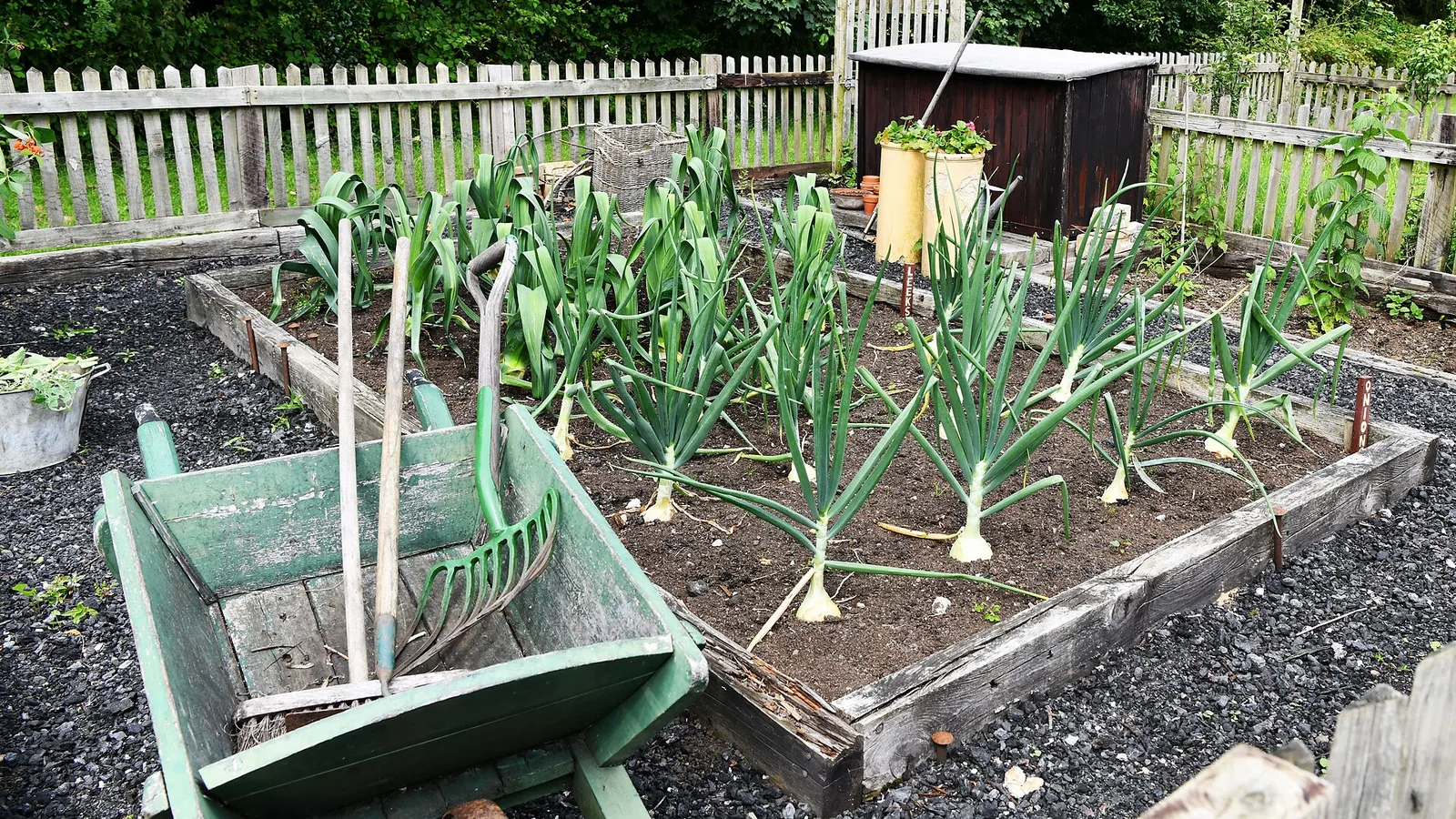
Onions with swelling bulbs growing in a raised garden bed
How to grow

Onions

Takes a hard frost. Start indoors 12 to 16 weeks before your last frost; plant out 2 to 4 weeks before your last frost; sow outdoors 4 to 6 weeks before your last frost. First harvest 100 to 120 days from sowing.

Photo: “Onions doing well in the stationmaster’s garden, Beamish” by Michael Garlick, CC BY-SA 2.0, via Wikimedia Commons (cropped). The cropped version is shared under the same licence.

  • Full sun6–8 hours or more
  • 3–4 in apartRows 8–18 in
  • 100–120 daysFrom sowing
  • Soil 35 °F +pH 6.0–7.0
  • 1 in a weekEven watering
  • HardyTakes a hard frost

Your dates

Put in your ZIP code to see when to start, plant and harvest onions where you live, from your own frost dates.

Look up the frost dates for this ZIP code
Open my planting calendarOpen the planting calendar Add this crop to the calendar saved on this device

From seed to harvest

  1. PlantSet in the groundWeek 0
  2. SproutFirst shoots showWeek 1–2
  3. Leaf growthLeaves fill outWeek 3–6
  4. Bulb swellsBulbs fattenWeek 10–13
  5. Tops fallLeaves flop and yellowWeek 13–16
  6. HarvestReady to pickWeek 14–17

How to plant and grow

  1. Pick the right type

    Bulbs form in response to day length. Northern gardens need long-day varieties; southern gardens do better with short-day types.

  2. Start seeds indoors

    Sow seed indoors 8 to 12 weeks before setting out. Trim the tops to about 4 inches if they flop over.

  3. Plant out early

    Set out transplants or sets, or sow seed, as soon as the soil can be worked in spring. Late planting tends to give leaves without bulbs.

  4. Space for big bulbs

    Set plants or thin seedlings to 3 to 4 inches apart in rows 8 to 18 inches apart. Keep weeds pulled, since onions compete poorly.

  5. Water steadily

    Give about 1 inch a week and keep the soil evenly moist. Stop watering once the tops start to fall over.

  6. Harvest and cure

    Lift bulbs when about half the tops have fallen. Dry them in shade for 1 to 2 weeks until necks and skins are papery, then store cool and dry.

Common problems

Onion thripsPest

What you'll see: Silvery streaks and blotches on leaves, with tiny black specks. The tiny, slender insects hide deep in the neck.

Prevent

  • Control weeds and remove onion culls and debris.
  • Overhead watering or heavy rain knocks numbers down.

Organic options

  • Insecticidal soap or spinosad, aimed down into the neck. Look for OMRI Listed products.

Conventional options

  • Several insecticides are labeled; check the crop is listed. Thrips grow resistant when one product is used over and over.

Bee caution: Don't spray open flowers. Spray in the late evening, when bees aren't flying.

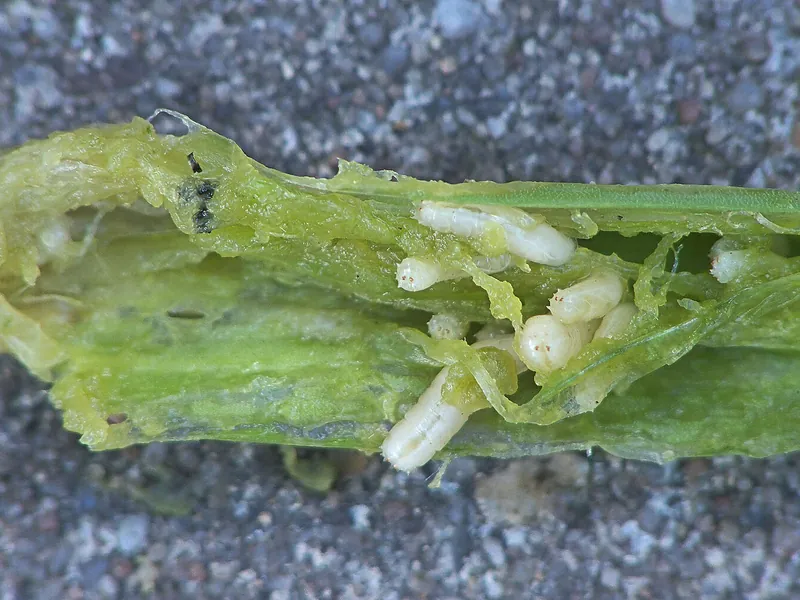
White onion maggots feeding inside a split leek stem
Photo: “Delia antiqua maggots at Allium porrum , uienvlieg maden op prei (1)” by Rasbak, CC BY-SA 3.0, via Wikimedia Commons (cropped). The cropped version is shared under the same licence.

Onion maggotPestNo spray helps

What you'll see: Young onions, garlic, leeks, shallots and chives wilt and yellow. Small white maggots tunnel in the bulb or stem, which may rot.

Prevent

  • Cover rows with row cover at planting, and bury the edges.
  • Plant far from last year's onions, and never cover ground that had maggots.
  • Remove culled onions and debris after harvest.

Organic options

  • Pull and destroy infested plants with the maggots in them.

Conventional options

  • None for home gardens. No insecticide is available to treat the soil before planting.
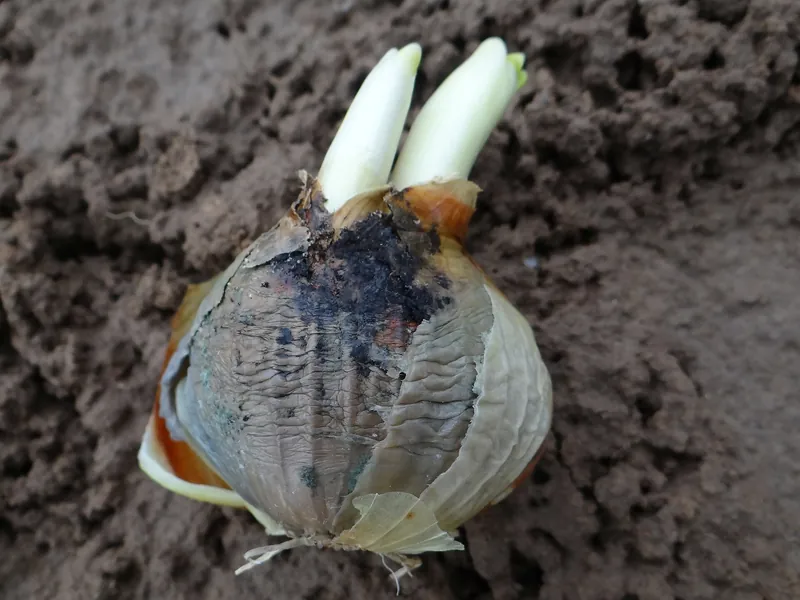
An onion bulb rotting with grey neck rot mould
Photo: “Botrytis allii a2 (1)” by Jerzy Opioła, CC BY-SA 4.0, via Wikimedia Commons (cropped). The cropped version is shared under the same licence.

Neck rotDiseaseNo spray helps

What you'll see: Stored bulbs soften and turn brown from the neck down, often with gray mold. Signs usually show a month or two after harvest.

Prevent

  • Let tops fall and necks dry fully before storing; cure bulbs somewhere warm and airy.
  • Go easy on nitrogen late in the season.
  • Store bulbs cool and dry, with air flow.

Organic options

  • Sort stored bulbs often and remove any soft ones.

Conventional options

  • None for home gardens. Curing is the control.
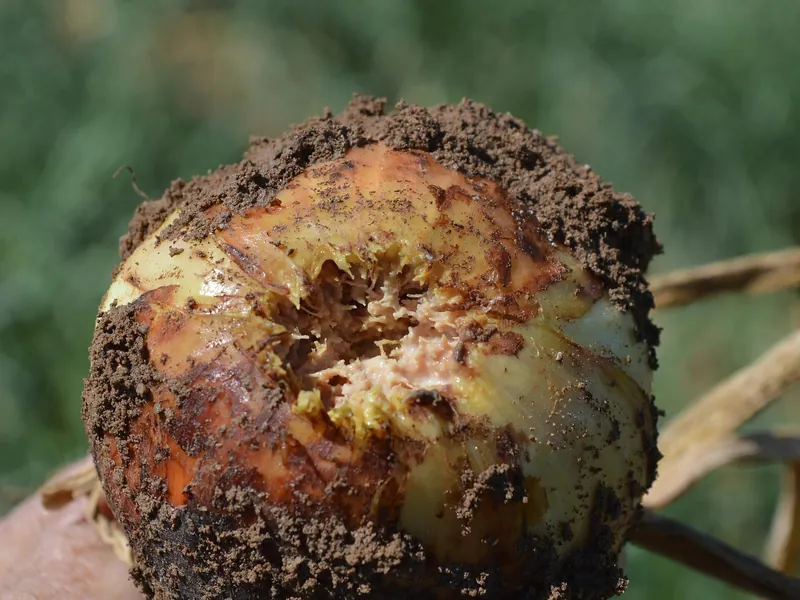
An onion bulb rotting from the base with Fusarium basal rot
Photo: “Fusarium basal rot of onion” by Howard F. Schwartz, Colorado State University, Bugwood.org, CC BY 3.0, via Wikimedia Commons (cropped).

Basal rotDiseaseNo spray helps

What you'll see: Leaf tips yellow and die back, roots rot away, and the base of the bulb turns soft and brown, sometimes with white mold. Some bulbs look fine until they rot in storage.

Prevent

  • Grow onions and garlic in a different bed for 3 to 4 years.
  • Buy disease-free sets or start from seed.
  • Plant in well-drained or raised beds, and control onion maggots, which wound bulbs.

Organic options

  • Pull and discard plants with rotting bases.
  • Check bulbs at harvest and store only sound, dry ones somewhere cool.

Conventional options

  • None for home gardens. No spray cures a rotting bulb.

Read and follow the product label: it is the law. It sets the rate, the crops it is for, and the days between spraying and picking. Products registered vary by state; for organic growing, look for products allowed under the USDA National Organic Program (OMRI Listed). We name active ingredients, not brands or rates.

ShareShare a link to this growing guide.

Share this growing guide

The link opens this growing guide, so anyone can read it and look up their own planting dates.

FacebookShare this link on Facebook.XShare this link on X.LinkedInShare this link on LinkedIn.RedditShare this link on Reddit.PinterestShare this link on Pinterest.EmailEmail this link.Open your device's share menu. Copy the link to your clipboard.

Growing more than you can eat? Sell it at a farm stand. TallyTill takes cards and keeps count of what sells, and the Stand plan is free.
Get started with TallyTill for free

Sources

Planting dates and growing facts checked against these university extension and USDA pages:

Growth-stage drawings: TallyTill.

Reconnecting…
One moment — we're restoring your session.